Mon–Fri 7 AM – 5 PM · Serving Mesa & the East Valley
Buying an electric vehicle is the easy part. Figuring out how to charge it efficiently at home without overloading your electrical system or overspending on equipment you don’t need is where most Mesa homeowners get stuck. With dozens of charger models on the market and a wide range of installation scenarios, from older ranch-style homes to newer builds with larger garages, there isn’t a single “best” charger for everyone.
This guide breaks down the factors that should drive your decision: your vehicle and driving habits, your home’s existing electrical capacity, the trade-offs between charger types, and the installation details that affect both cost and long-term reliability. By the end, you’ll have a clear framework for choosing the right setup for your specific situation.
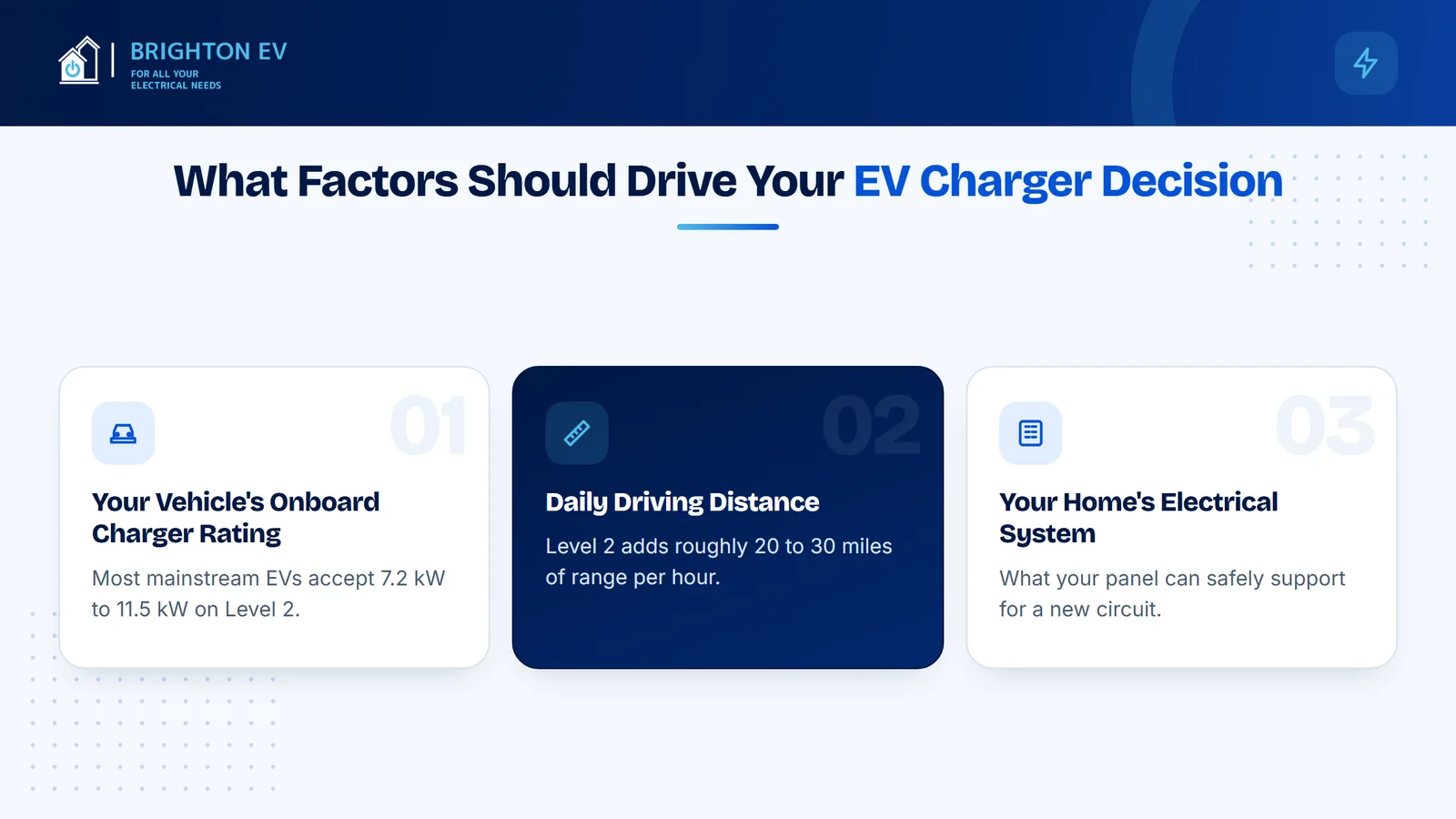
The right charger comes down to three things: what your vehicle can actually accept, how much driving you do each day, and what your home’s electrical system can safely support. Skipping any one of these factors is how homeowners end up with equipment that’s either underpowered for their needs or an unnecessary expense.
Every EV has a maximum charging rate it can accept, regardless of how powerful the home charger is. Most mainstream EVs accept between 7.2 kW and 11.5 kW on Level 2, while some plug-in hybrids cap out much lower, often around 3.3 kW. Check your owner’s manual or manufacturer specs before assuming a faster charger will charge your car faster. If your car’s onboard charger is the bottleneck, a faster unit won’t help.
A typical Level 2 home charger adds roughly 20 to 30 miles of range per hour, depending on the vehicle and charger output. If your daily commute is under 40 miles, overnight Level 1 charging (adding about 3 to 5 miles per hour) may be enough. Drivers who regularly put on 60 to 100 miles a day, or who want a full charge in a few hours rather than overnight, generally need Level 2.
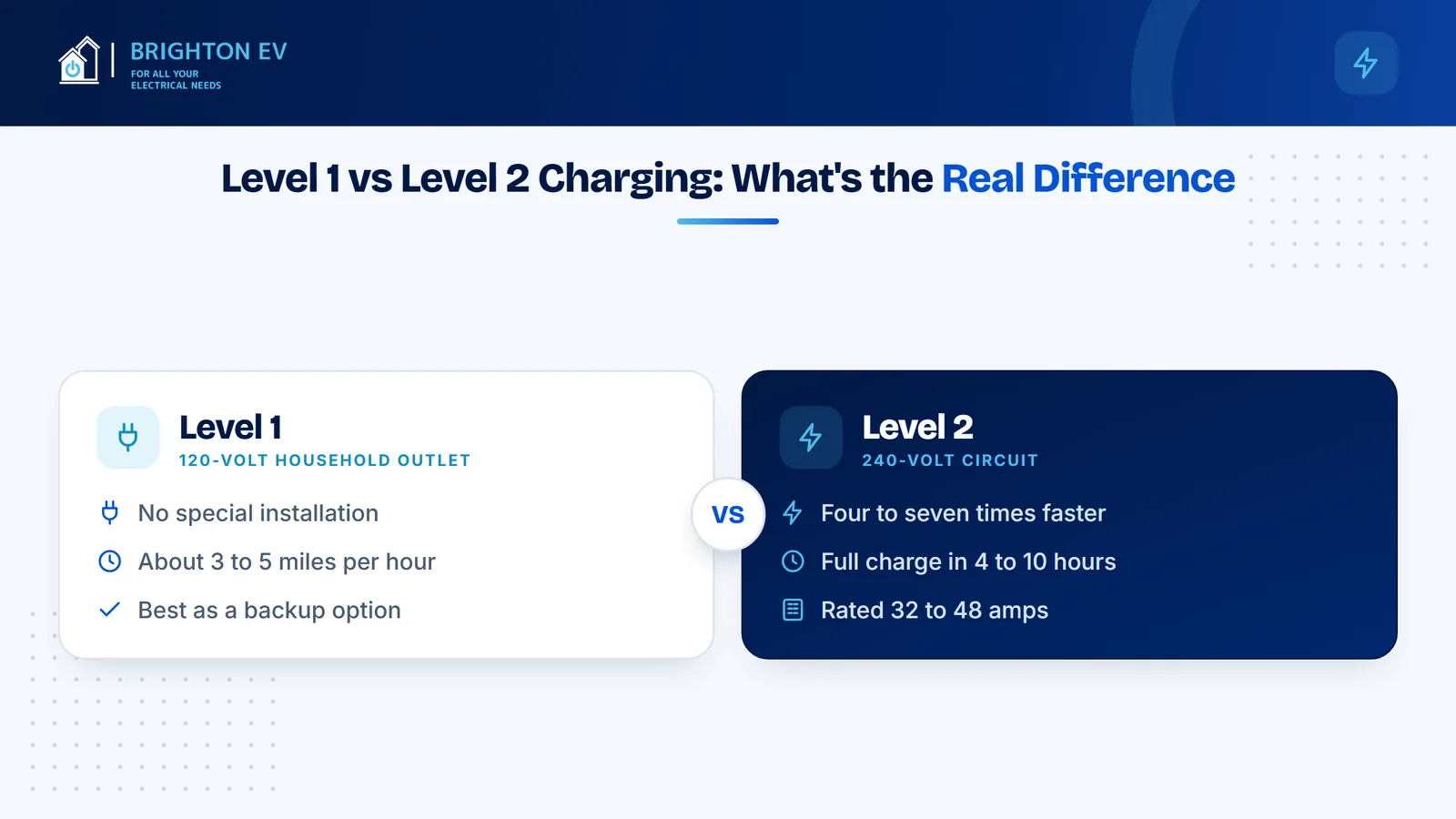
Level 1 uses a standard 120-volt household outlet and requires no special installation, while Level 2 uses a 240-volt circuit and delivers roughly four to seven times the charging speed. The choice between them depends mainly on how much range you need replenished overnight.
According to the U.S. Department of Energy, a Level 2 charger can fully recharge most EV batteries in 4 to 10 hours, compared to a full day or more on a standard Level 1 outlet.
Level 1 charging uses the charging cable that comes with most EVs, plugged into any standard outlet. It requires no electrician visit and no new circuit, but it’s slow: a full charge from empty can take 20 to 40 hours depending on battery size. It works best as a backup option or for plug-in hybrids with smaller batteries.
Level 2 charging requires a dedicated 240-volt circuit, similar to what powers an electric dryer or oven, along with either a hardwired unit or a plug-in charger rated for the circuit. Most Level 2 home chargers are rated between 32 and 48 amps, and a full charge typically takes 4 to 10 hours depending on battery size and charger output.
With Arizona’s summer heat pushing air conditioning and pool equipment loads higher, many homeowners want charging done overnight on off-peak utility rates without tying up an outlet for a day and a half. That’s a big part of why Level 2 has become the default recommendation for anyone driving an EV as a daily vehicle rather than an occasional second car.
Beyond charging speed, the type of charger hardware you choose affects durability, cost, and flexibility. The main decision points are hardwired versus plug-in units, and for Tesla owners, whether to use a brand-specific charger or a universal one.
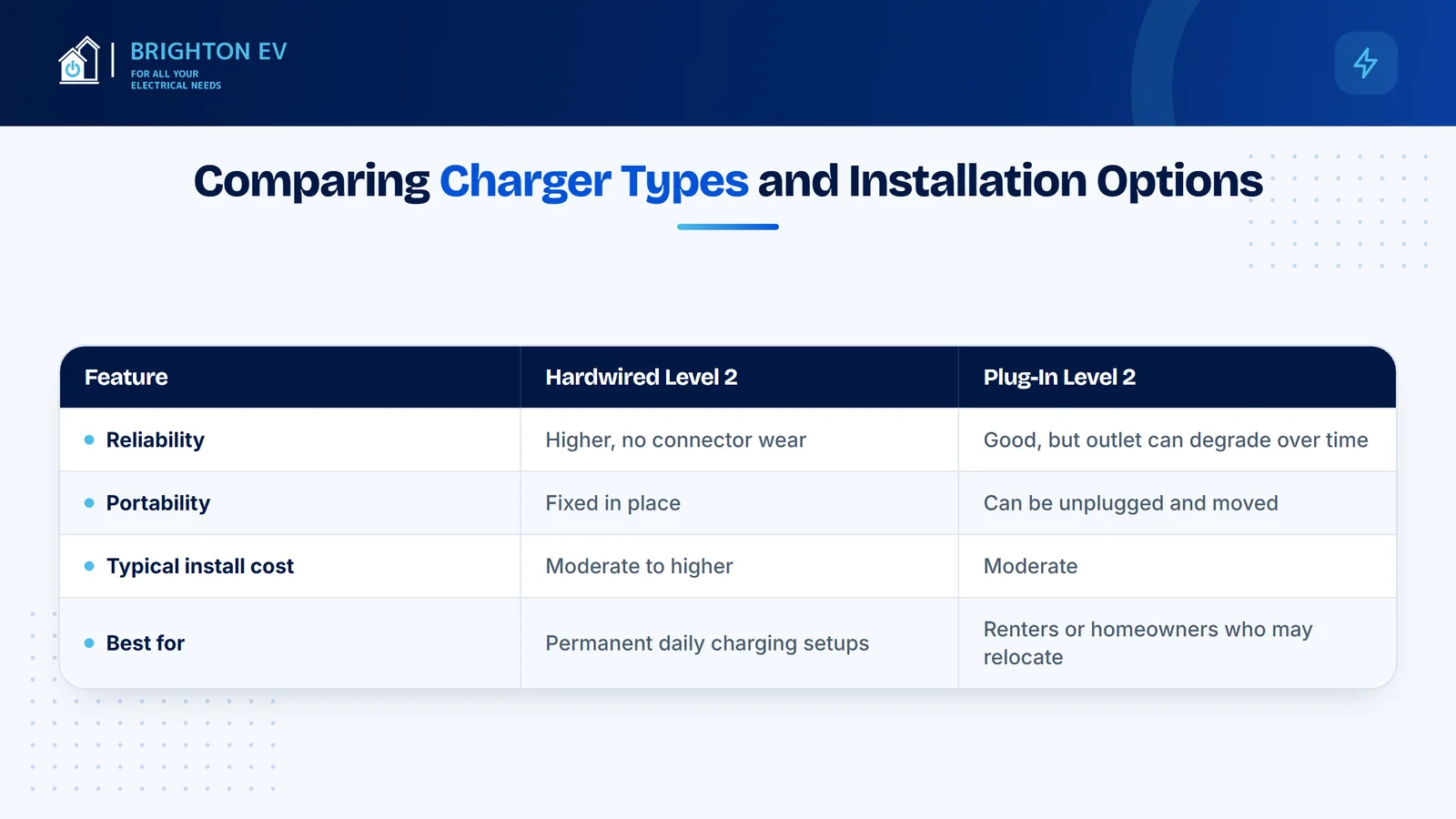
A hardwired charger is permanently wired into your electrical system with no plug or outlet involved, while a plug-in charger connects to a dedicated 240-volt outlet like a NEMA 14-50. Hardwired units are generally considered more reliable for daily use since there’s no connector to wear out, but plug-in units offer flexibility if you move or want to take the charger with you.
Tesla owners can choose a Tesla-specific Wall Connector, which is compact and integrates with the Tesla app, or a universal Level 2 charger that works with any EV using the proper adapter. If a Tesla is your only EV and you don’t plan to switch brands, the Tesla charger is often simpler. If your household has, or might get, a non-Tesla EV, a universal charger avoids needing an adapter down the road.
The table below compares the two most common home charger setups side by side.
| Feature | Hardwired Level 2 | Plug-In Level 2 |
|---|---|---|
| Reliability | Higher, no connector wear | Good, but outlet can degrade over time |
| Portability | Fixed in place | Can be unplugged and moved |
| Typical install cost | Moderate to higher | Moderate |
| Best for | Permanent daily charging setups | Renters or homeowners who may relocate |
For most owner-occupied homes planning to keep the vehicle and property long term, a hardwired setup tends to offer better reliability with only a modest cost difference.
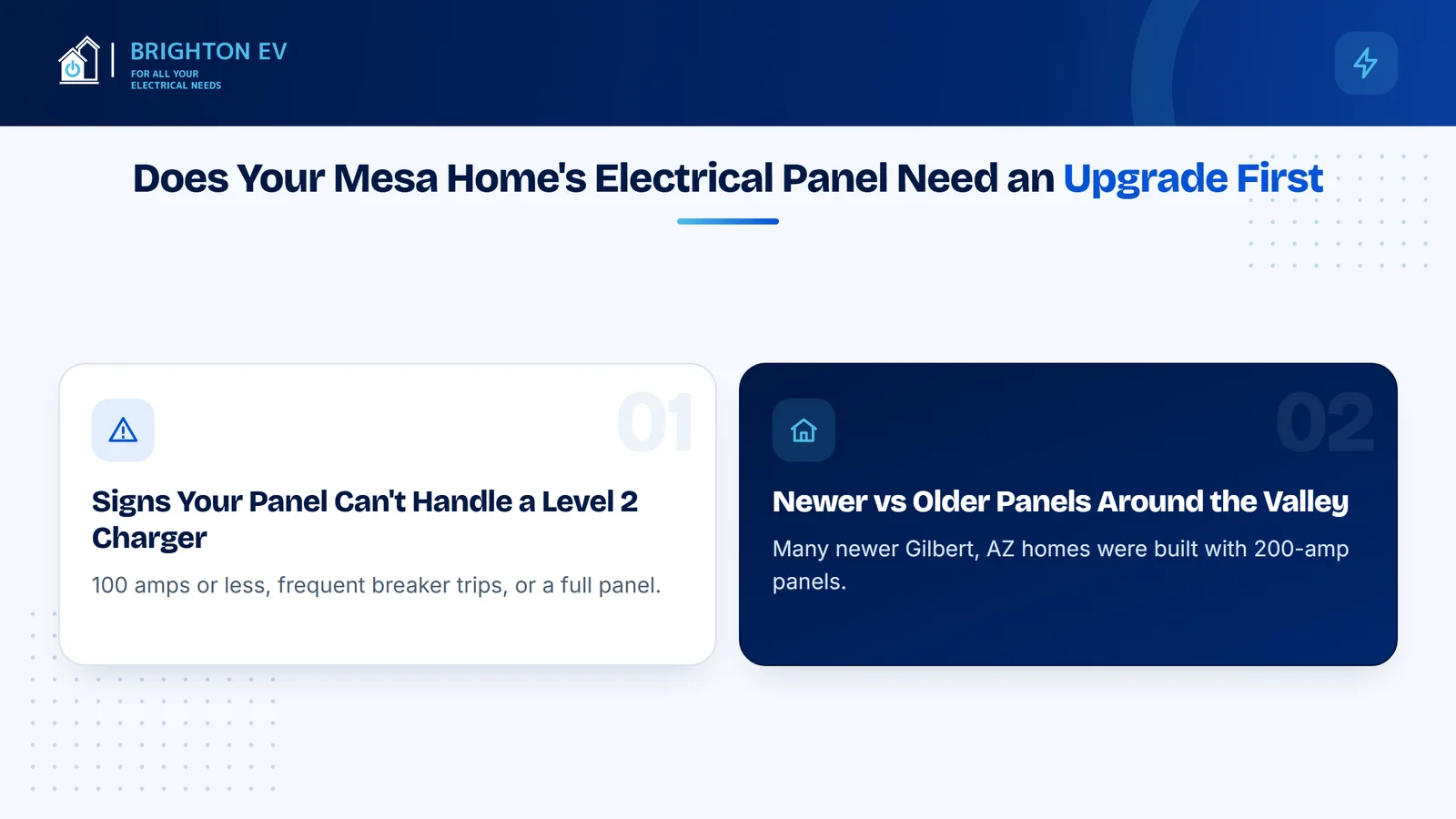
Before choosing a charger, you need to know whether your panel has enough spare capacity to add a 240-volt EV circuit without exceeding its rated load. This is the single most common reason EV charger installations get delayed or cost more than expected.
Installing a 240-volt EV circuit on an undersized panel without a proper load calculation can lead to nuisance breaker trips or, in worse cases, overheated wiring. This step should not be skipped.
Common warning signs include a panel rated at 100 amps or less with little remaining capacity, frequent breaker trips when running multiple large appliances, or a panel that’s already full with no open breaker slots. A licensed electrician can run a load calculation, a standard process under the National Electrical Code, to determine exactly how much capacity is available.
Panel capacity varies quite a bit depending on when a home was built. Many homes in newer Gilbert, AZ subdivisions were built with 200-amp panels as standard, which usually leaves enough headroom for a Level 2 charger without any upgrade. Older homes in parts of Mesa, built with 100-amp service decades ago, are more likely to need an electrical panel upgrade before a Level 2 charger can be added safely.
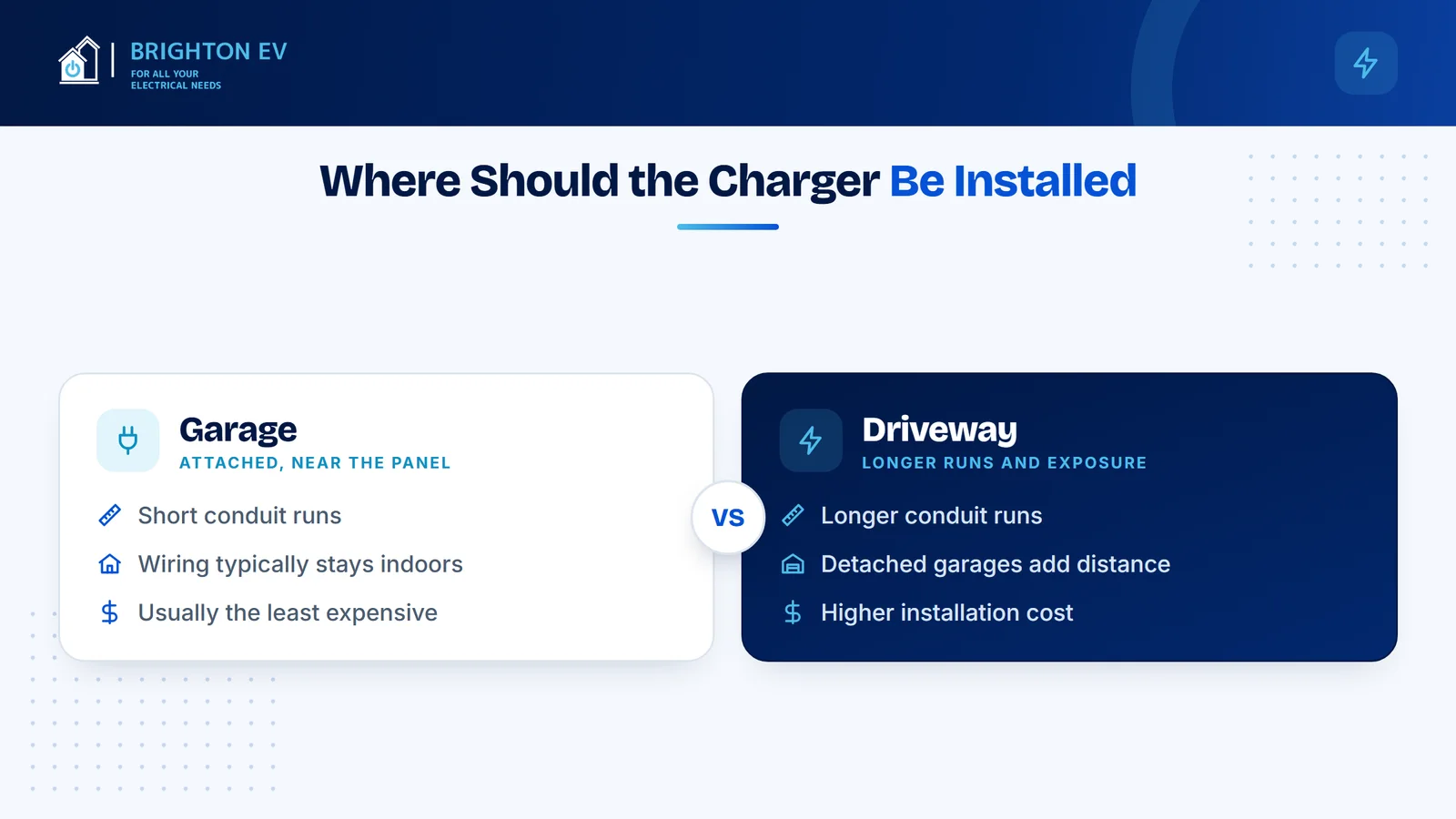
Installation location affects both upfront cost and day-to-day convenience. The closer the charger is to your electrical panel, and the more direct the conduit path, the less labor and material the job requires.
An attached garage near the main panel is usually the simplest and least expensive installation location, since conduit runs are short and typically stay indoors. Driveway-mounted chargers or those on detached garages require longer conduit runs, sometimes underground, which adds labor and material costs.
Newer master-planned communities in places like Gilbert, AZ often have larger lots with detached garages or extended driveways, which can mean longer conduit runs between the panel and the charger location compared to a more compact Mesa floor plan. It’s worth walking the planned route with your electrician before finalizing a quote, since distance and any obstacles like concrete slabs or landscaping can change the price significantly.
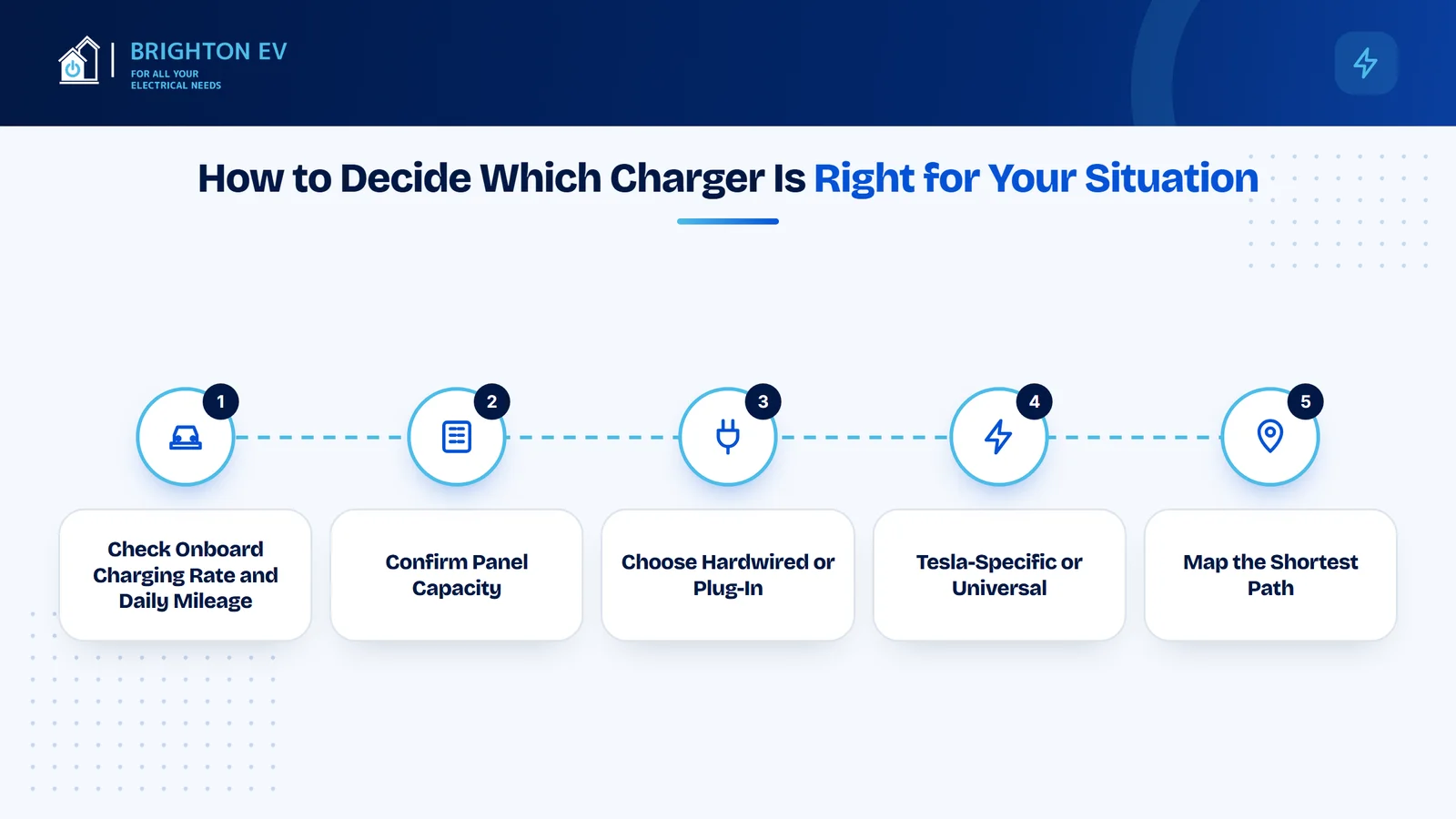
A simple way to narrow down your decision is to work through your situation in order: vehicle needs, panel capacity, and installation logistics.
Use this sequence to land on the right choice:
1. Check your EV’s maximum onboard charging rate and your typical daily mileage.
2. Confirm your panel’s available capacity with a licensed electrician.
3. Decide between hardwired and plug-in based on whether you want a permanent or portable setup.
4. If you drive a Tesla, decide whether a Tesla-specific charger or a universal model better fits your household’s future vehicle plans.
5. Map out the shortest practical path from your panel to the charger location to estimate installation cost.
Many homeowners find it faster to have an electrician handle steps 2 through 5 during a single site visit rather than researching panel capacity and conduit routing on their own. If you’re ready to move forward, scheduling EV charger installation in Gilbert, AZ with a licensed electrician ensures the charger choice, panel assessment, and permit process are handled together instead of as separate steps.
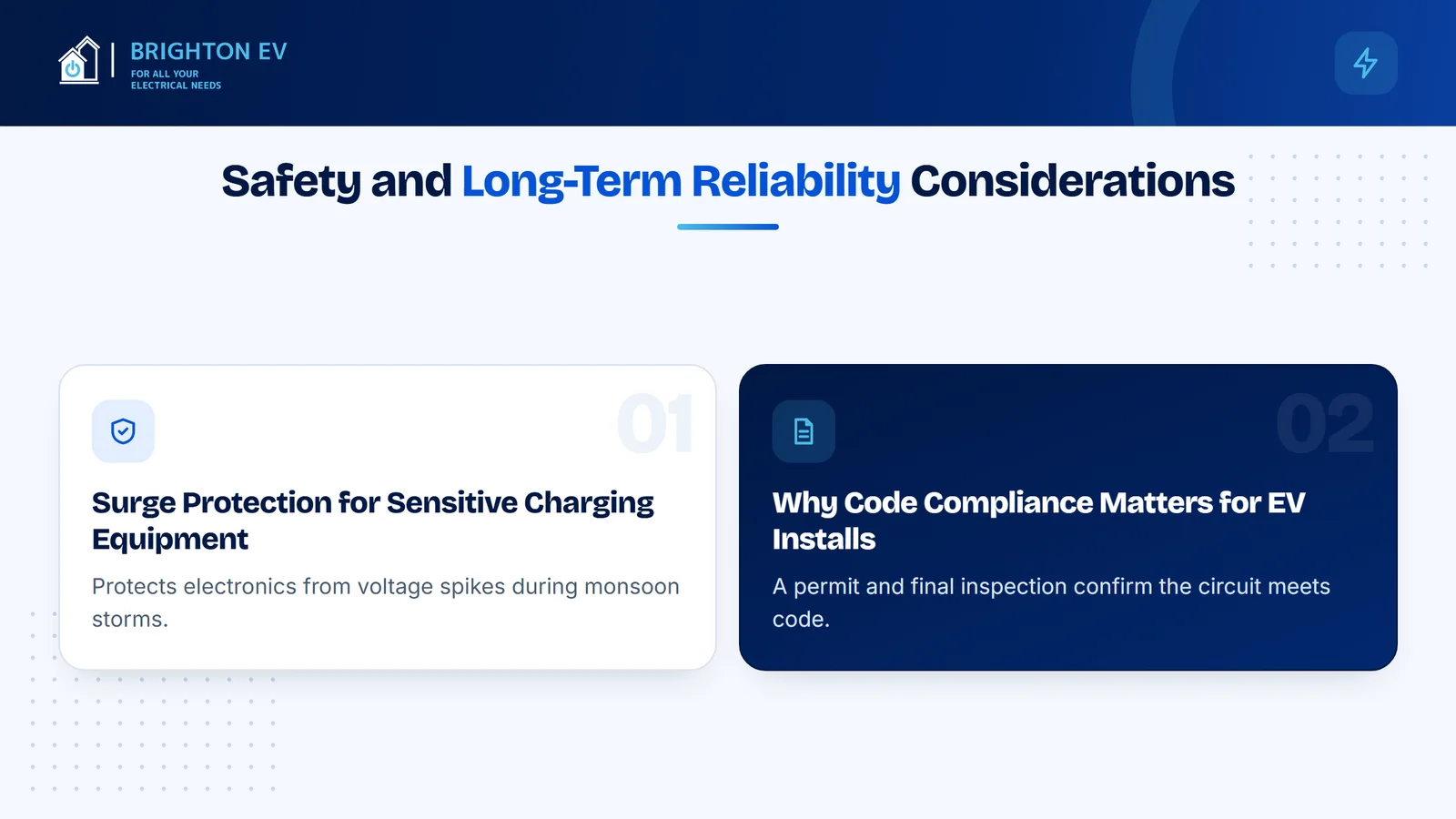
Choosing a charger involves more than speed and cost. The electrical safety of the installation affects both your home’s protection and the charger’s lifespan.
EV chargers contain sensitive electronics that can be damaged by voltage spikes from lightning strikes or grid fluctuations, which are more common in Arizona during monsoon season. Surge protection & safety upgrades installed at the panel level add a layer of protection for the charger and other connected electronics in the home.
An EV charger installation typically requires a permit and a final inspection to confirm the circuit, breaker, and wiring meet current electrical code. Code compliance inspections confirm the work meets these standards, which matters both for safety and for avoiding issues when selling the home later, since unpermitted electrical work can come up during a real estate inspection.
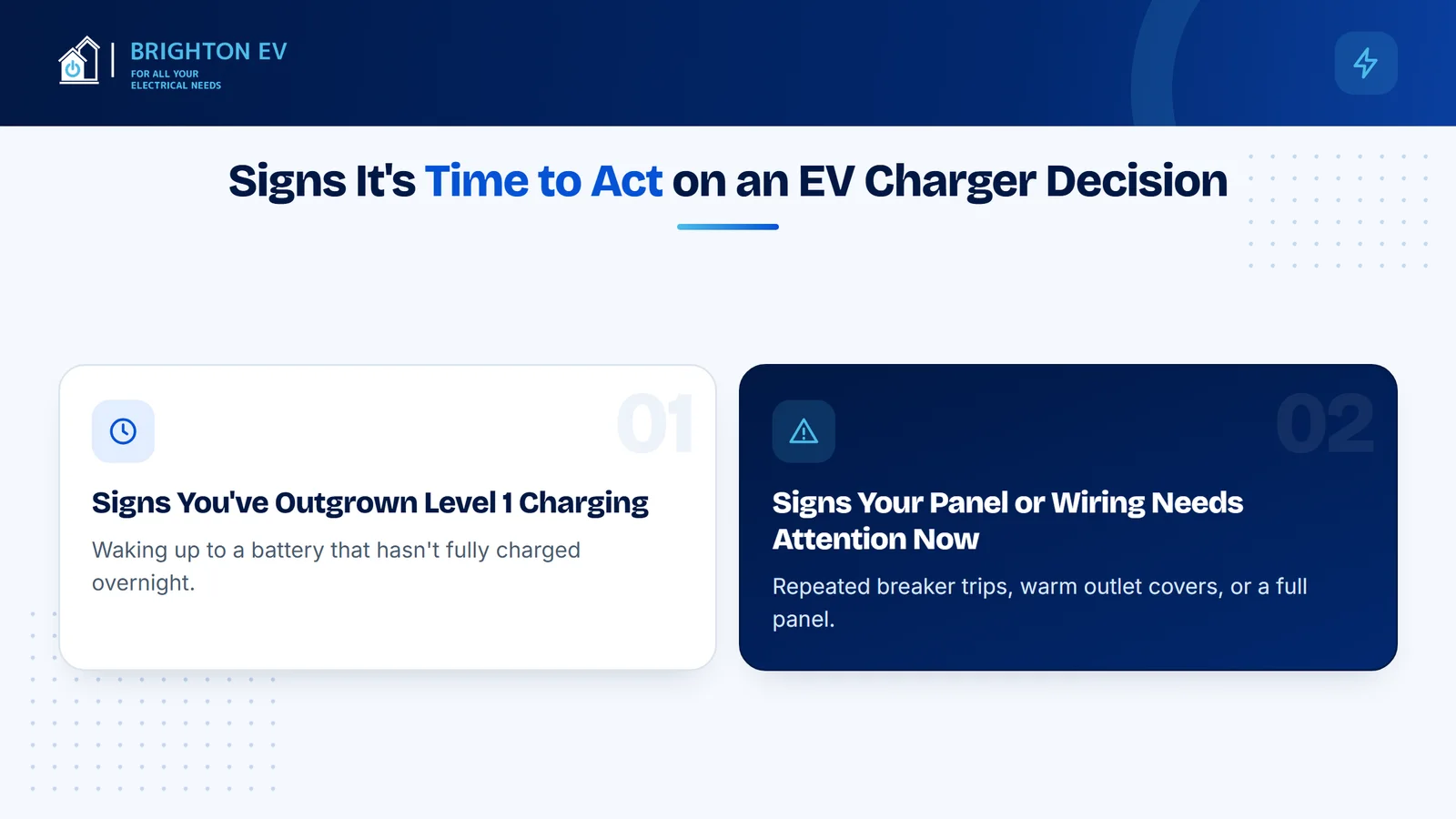
Some situations make the decision more urgent than others. Recognizing these signs can help you avoid relying on slow Level 1 charging longer than necessary or delaying a panel upgrade until it becomes a bigger problem.
If you’re consistently waking up to a battery that hasn’t fully charged overnight, or you’re avoiding longer trips because of charging time, it’s a clear sign to move to Level 2. Households adding a second EV also typically need Level 2 speed to keep both vehicles charged on a usable schedule.
Breakers that trip repeatedly, warm outlet covers, or a panel that’s already at capacity before adding an EV circuit are signs to address the electrical system promptly rather than after the charger is installed. These are also common reasons homeowners end up needing broader residential electrical services beyond just the EV circuit itself.
For homeowners across the Greater Phoenix Area weighing these options, Brighton EV provides licensed electrical expertise covering everything from panel assessments and safety upgrades to full home charging setups. Whether you’re still comparing charger types or ready to schedule an installation, it helps to look at available services and get professional guidance before making a final decision. Reach out to our team to talk through your specific home and vehicle needs.
Most home Level 2 EV charger installations range from about $500 to $2,500, depending on whether a panel upgrade is needed and how far the charger is from the electrical panel. Simple garage installs near the panel sit at the lower end, while detached garage or long conduit runs push costs higher.
Yes, Mesa requires an electrical permit for EV charger installations, along with a final inspection to confirm the work meets current electrical code. A licensed electrician typically handles the permit application as part of the installation process.
It’s not recommended. A Level 2 charger requires a dedicated 240-volt circuit sized correctly for the unit, which involves panel load calculations and code-compliant wiring that should be handled by a licensed electrician rather than a DIY install.
A straightforward installation with adequate existing panel capacity usually takes 2 to 4 hours. Jobs requiring a panel upgrade or longer conduit runs can take a full day or more.
Most EV owners add roughly 30 to 60 kWh per week of charging for average driving habits, which typically adds a moderate, predictable amount to a monthly electric bill. Charging overnight on off-peak utility rates, where available, can help reduce that cost.
It depends on the charger’s rated output and your vehicle’s maximum charging rate. A 50-amp circuit comfortably supports most 32- to 40-amp chargers, while a 60-amp circuit is needed for higher-output 48-amp chargers. An electrician can confirm the correct circuit size for your specific charger model.
No. Tesla vehicles use a proprietary connector in North America (though newer models support the emerging NACS standard), while most other EV brands use the J1772 connector for Level 2 charging. Adapters are available to bridge the two, which is worth confirming before buying a charger.
Tell us what you need repaired or installed, and we’ll help plan the right electrical service.
By requesting an estimate, you agree that Brighton EV may call or text you about your request. Message & data rates may apply.