Mon–Fri 7 AM – 5 PM · Serving Mesa & the East Valley
If you’re planning to add a home charging station for an electric vehicle, one of the first questions is practical: how long will this actually take? The answer depends on more than the electrician’s schedule. It depends on your home’s existing electrical capacity, where the charger will be mounted, what kind of charger you’re installing, and whether local permitting is required.
This guide breaks down what happens during a typical EV charger installation, what factors speed it up or slow it down, and what homeowners across the Greater Phoenix Area can realistically expect from start to finish.
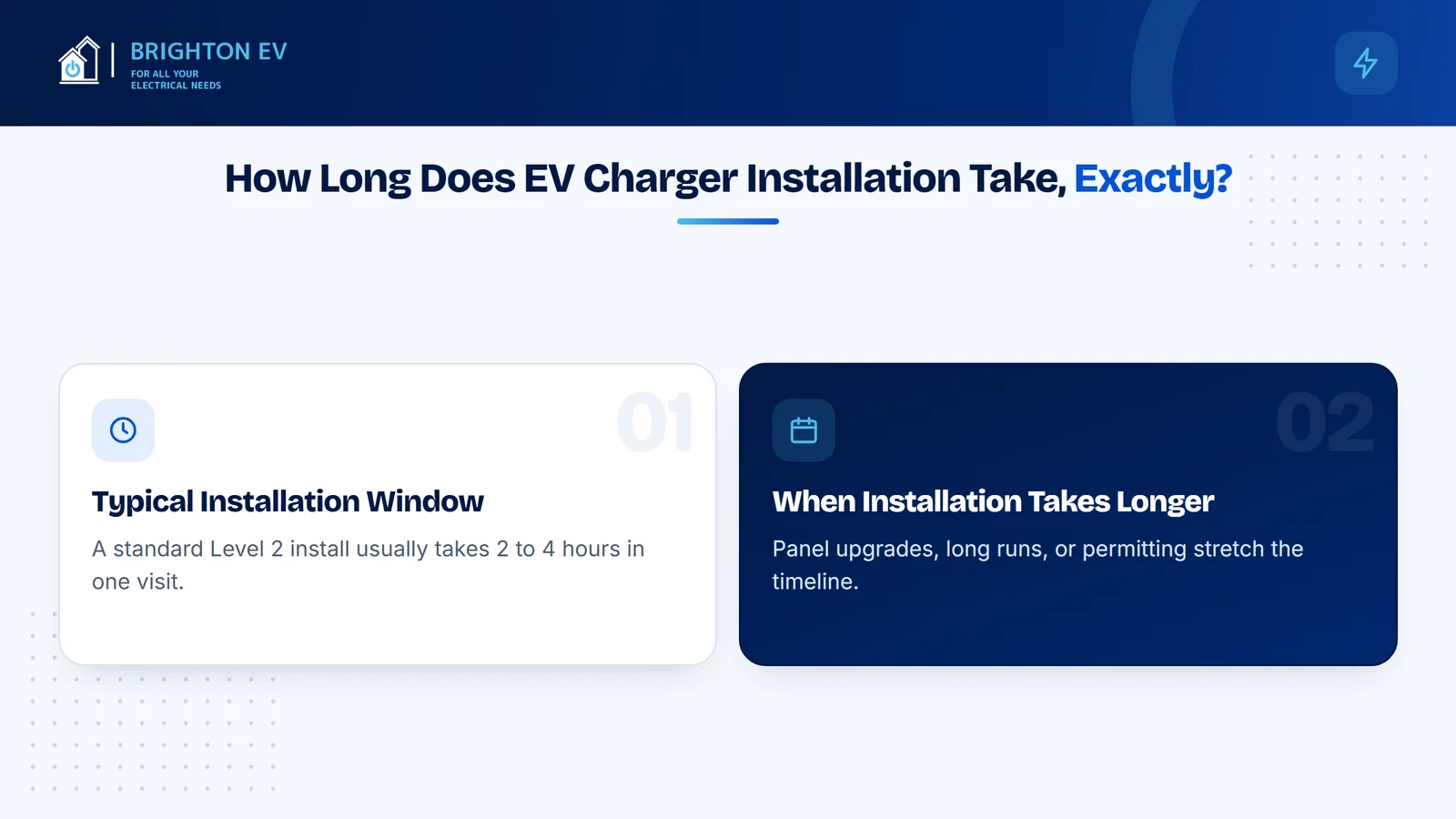
For a home with adequate electrical capacity and a charger location close to the main panel, the physical installation usually takes 2 to 4 hours. This covers running a dedicated circuit, mounting the charger, connecting the wiring, and testing the unit. More complex jobs, such as those requiring a long wire run, a subpanel, or trenching for an outdoor charger, can take a full working day.
The installation itself is only one part of the timeline. When you factor in scheduling an assessment, obtaining any required permit, and arranging a final inspection, the total project timeline from first call to fully operational charger often runs anywhere from a few days to two or three weeks. Homeowners who need an electrical panel upgrade first should expect the longest end of that range.
A licensed electrician can usually complete a standard Level 2 installation in one visit. This assumes the panel has open breaker space and sufficient amperage, the charger location is within a reasonable distance of the panel (commonly under 25 feet of wire run), and no drywall, concrete, or masonry needs to be cut into for the circuit path.
Jobs stretch beyond a single visit when the panel needs upgrading, when the charger is being mounted far from the panel or in a detached garage, or when local permitting requires an inspector visit before the system can be energized. In these cases, the on-site electrical work might still only take a few hours, but the overall project closes out over multiple days.
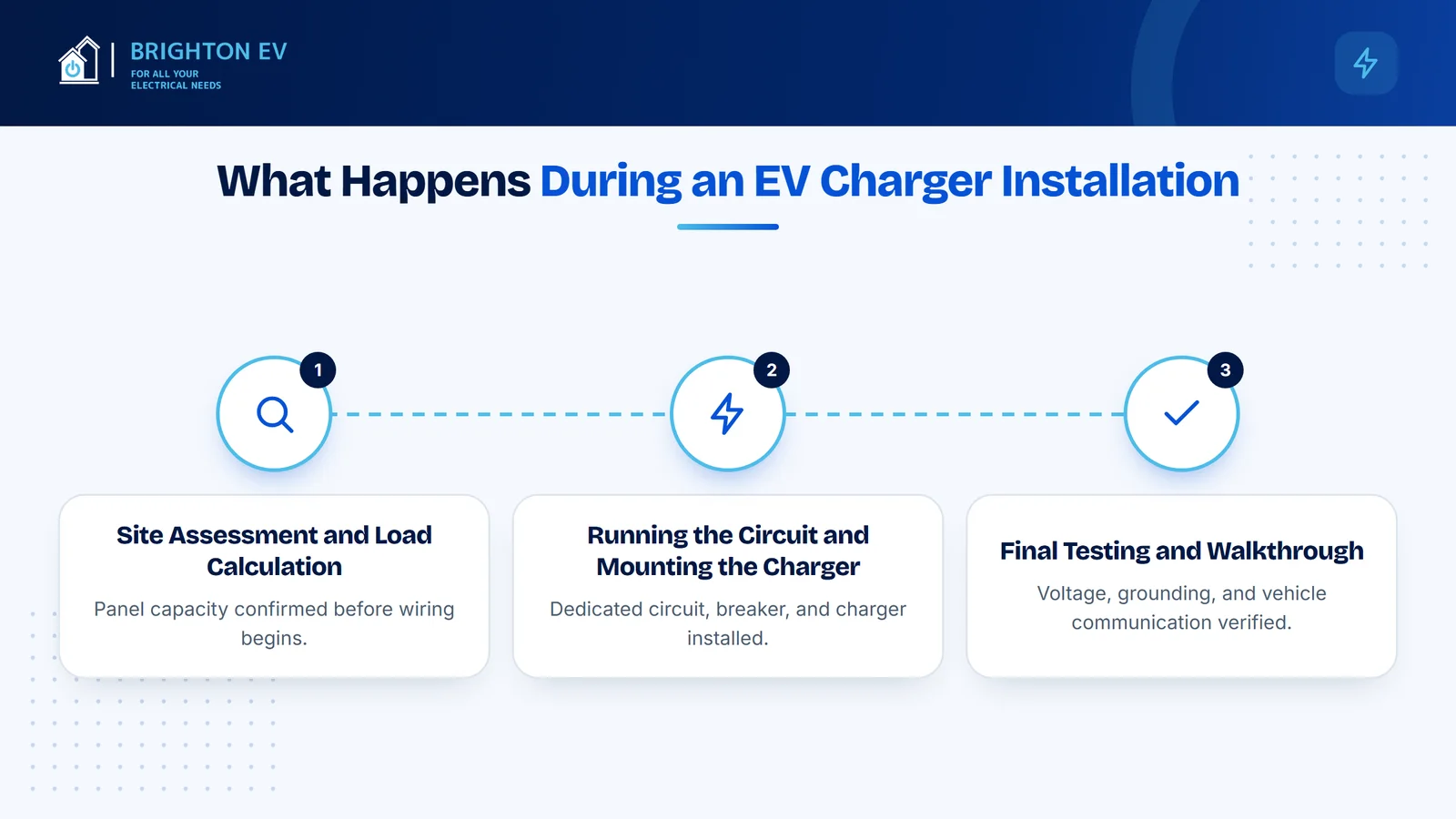
Every installation follows a similar sequence, regardless of the charger brand or home type. Understanding each stage helps explain why the time estimate varies so much from one home to the next.
Before any wiring begins, an electrician evaluates your electrical panel’s total capacity and performs a load calculation to confirm it can safely support the added draw of a charger. This step typically takes 30 to 60 minutes and determines whether you need a simple new circuit or a more involved electrical panel upgrade.
Once the plan is confirmed, the electrician runs a dedicated circuit from the panel to the charger location, installs the proper breaker, and mounts the charging unit on the wall. This is the bulk of the physical labor and generally takes 1.5 to 3 hours for a standard garage setup.
After the charger is wired and mounted, the electrician tests voltage, confirms proper grounding, and verifies the unit communicates correctly with the vehicle before walking you through basic operation. This final step usually adds 15 to 30 minutes to the visit.
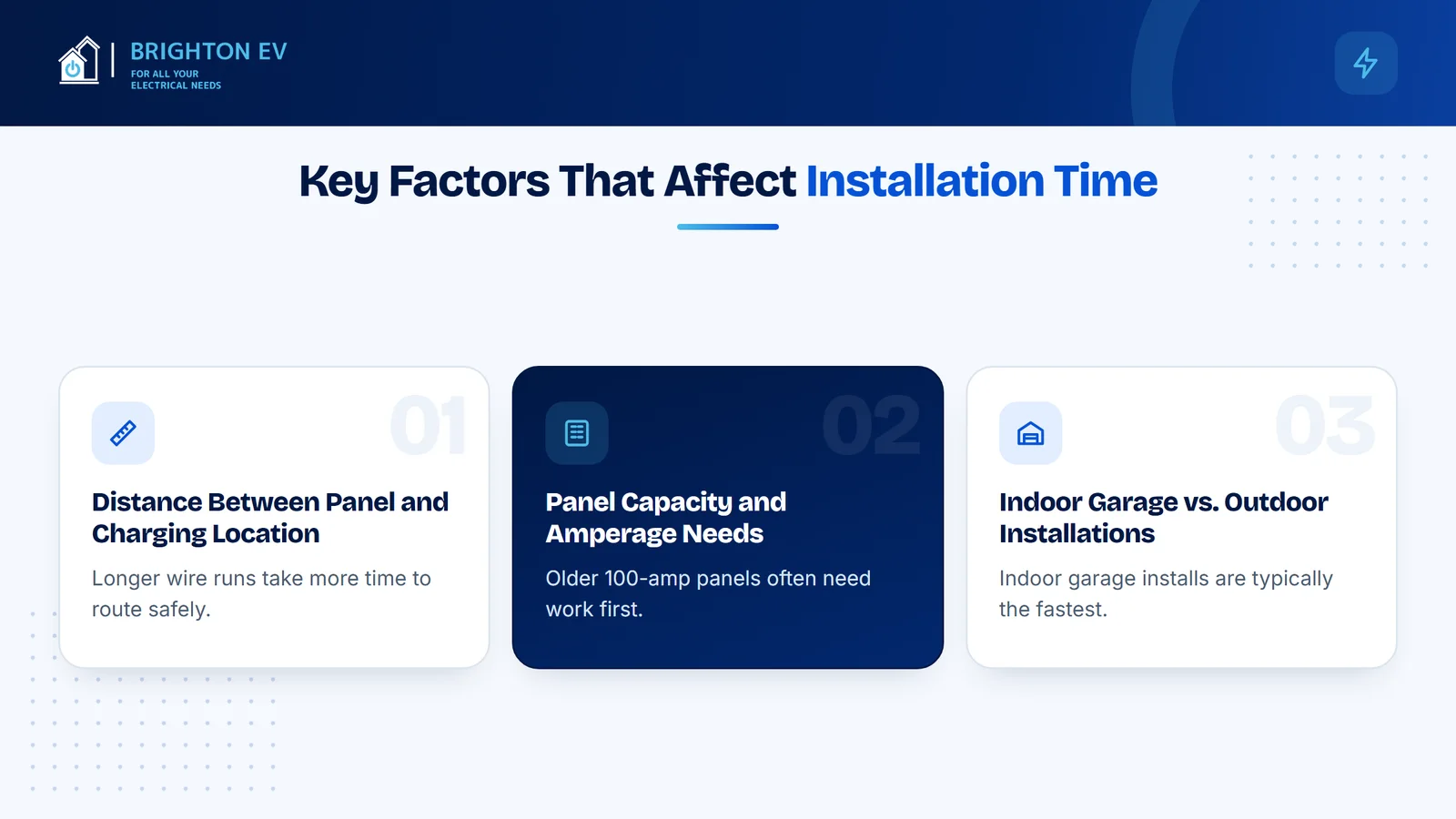
No two homes are wired the same way, so installation time varies based on a handful of predictable variables. Knowing these ahead of time helps set realistic expectations before scheduling.
A typical Level 2 home charger draws between 30 and 50 amps, roughly equivalent to running a central air conditioner, so panel capacity is one of the first things an electrician checks.
The farther the charger is from the main electrical panel, the longer the wire run, and the more time it takes to route cable safely through walls, attics, or conduit. A garage directly adjacent to the panel might take under an hour of wiring work, while a detached garage or a charger mounted on the opposite side of the house can add several hours.
Homes with older 100-amp panels or panels that are already near capacity from other appliances often need additional work before a charger can be added safely. This is one of the most common reasons an installation quoted as a half-day job turns into a full day.
Indoor garage installs are typically the fastest because the wiring is protected from the elements and the wall surface is usually drywall or exposed studs, which are easy to work with. Outdoor installations require weather-resistant enclosures, proper conduit, and sometimes trenching if the charger is mounted away from the house, all of which add time.
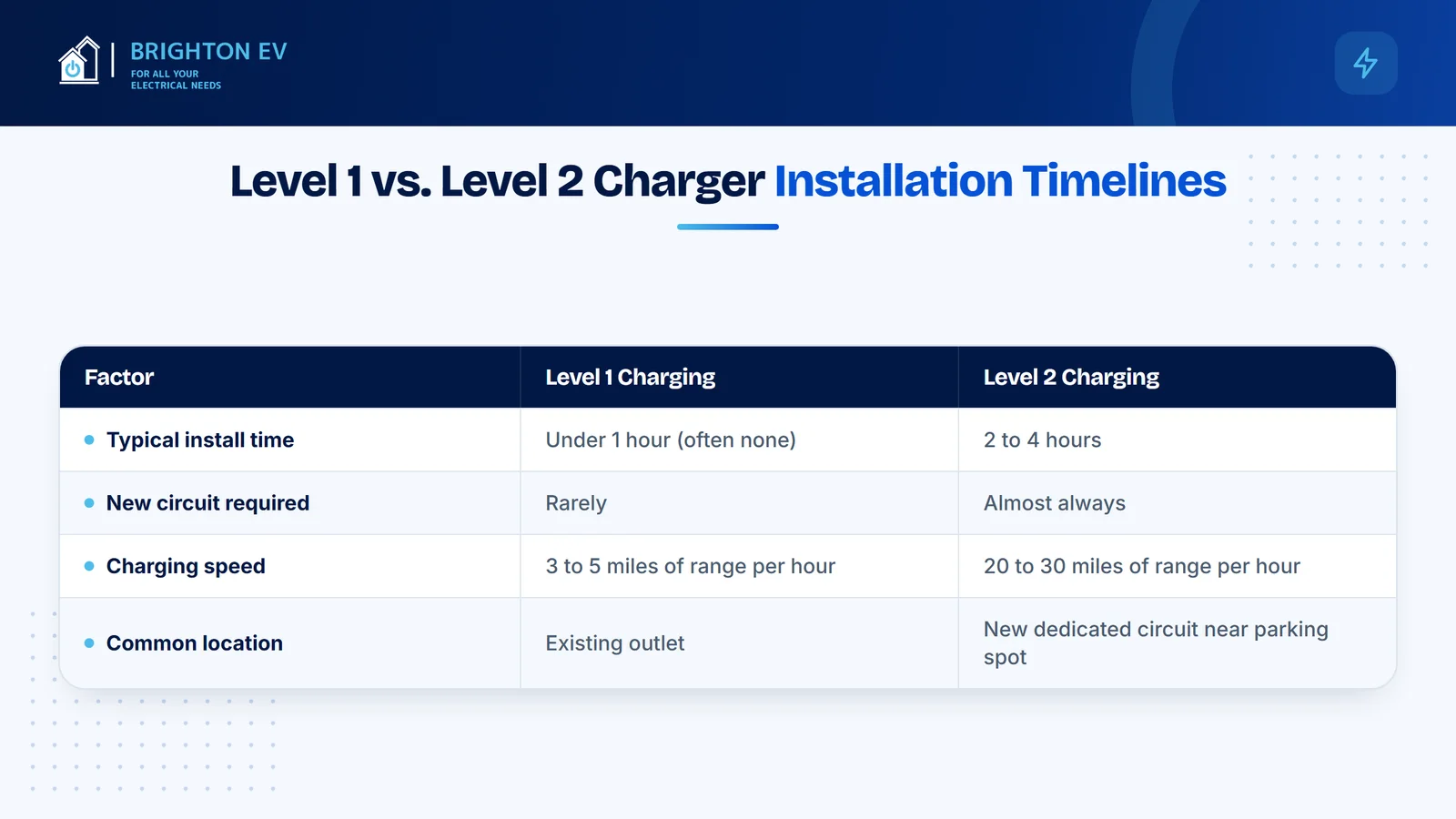
Not all home charging setups require the same amount of electrical work. The charger level you choose has a direct impact on how long installation takes and whether new wiring is even necessary.
Level 1 chargers plug into a standard 120-volt household outlet and often require no new circuit at all, since many homes in Gilbert, AZ already have a compatible outlet in the garage. In these cases, there may be little to no installation time beyond confirming the outlet is safe and properly grounded.
Level 2 chargers run on a 240-volt circuit, similar to an electric dryer or range, and almost always require a dedicated circuit to be installed. Because Level 2 charging is roughly three to five times faster than Level 1, it’s the setup most homeowners choose, which is why most installation timelines discussed by electricians refer to Level 2 work.
The table below compares the two options to show why Level 2 generally involves more on-site labor time despite delivering significantly faster charging.
| Factor | Level 1 Charging | Level 2 Charging |
|---|---|---|
| Typical install time | Under 1 hour (often none) | 2 to 4 hours |
| New circuit required | Rarely | Almost always |
| Charging speed | 3 to 5 miles of range per hour | 20 to 30 miles of range per hour |
| Common location | Existing outlet | New dedicated circuit near parking spot |
For most drivers who want a meaningful daily charge overnight, the extra installation time for Level 2 charging is a worthwhile trade-off for the much faster charging speed.
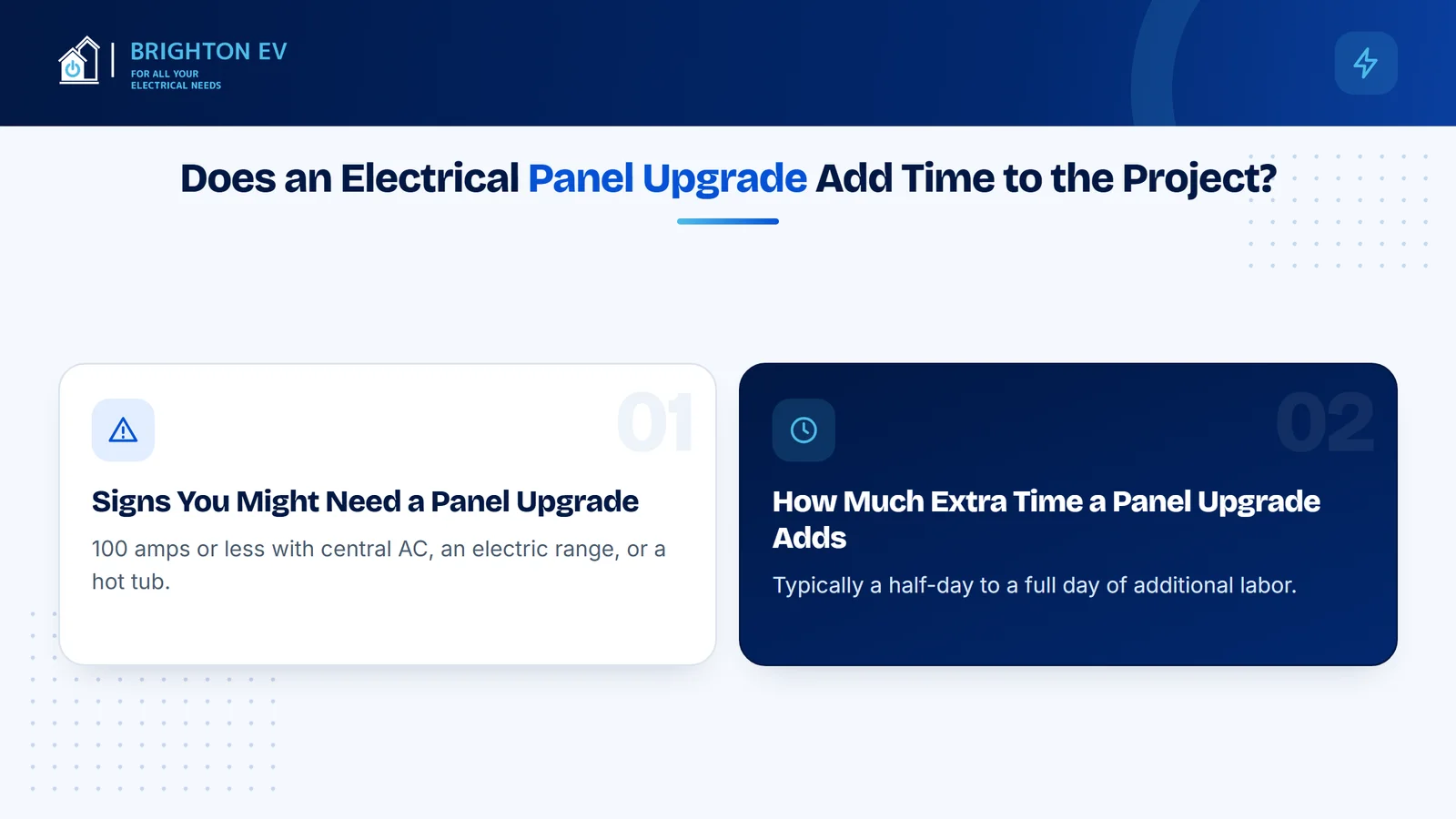
Yes, and it’s one of the biggest variables in the entire timeline. If the load calculation shows your panel doesn’t have enough spare capacity or physical breaker space for the new circuit, an electrical panel upgrade becomes part of the job.
Overloading an aging panel to accommodate a high-draw charger is a genuine fire and equipment-damage risk, which is why reputable electricians will not skip the load calculation step even if a homeowner is in a hurry.
Common indicators include a panel rated at 100 amps or less in a home with central air conditioning, an electric range, or a hot tub already drawing significant power, a panel with no open breaker slots, or a panel that’s original to a home built decades ago. An electrician can confirm this quickly during the initial assessment.
A panel upgrade typically adds a half-day to a full day of additional labor on top of the charger installation itself, since it involves disconnecting power, replacing the panel or adding a subpanel, and often coordinating with the utility company. Because this work affects the home’s entire electrical system, it’s frequently paired with related surge protection and safety upgrades to bring the whole system up to current standards in one visit rather than two.
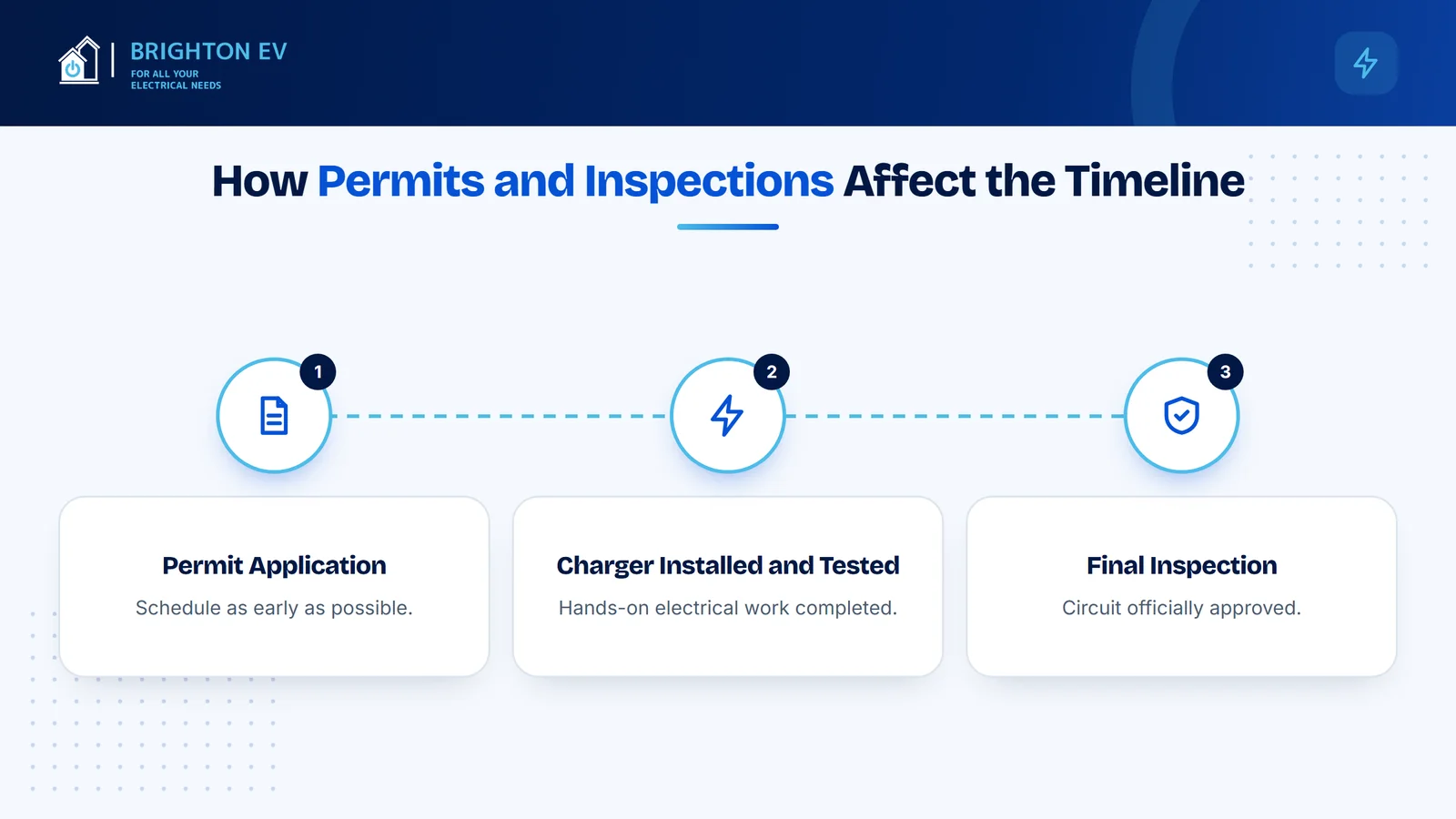
Beyond the physical labor, most jurisdictions require a permit for new circuit installation, and this step has its own timeline that runs separately from the hands-on electrical work.
Scheduling the permit application and inspection as early as possible, rather than after the charger is already mounted, typically shaves days off the total project timeline.
In towns like Gilbert, AZ, many homes sit within master-planned communities that carry both town permit requirements and homeowners association review for exterior electrical work, which can affect how quickly a project with an outdoor charger location moves forward. An electrician handling EV charger installation in Gilbert, AZ typically submits the permit application early in the process so the inspection can be scheduled without delaying the install date itself. Code compliance inspections confirm the new circuit meets current electrical code before the system is approved for everyday use.
Once the charger is installed and tested, many jurisdictions require a final inspection before the circuit is officially approved, even though the charger may already be functional. Depending on the inspector’s availability, this can take anywhere from a couple of days to about two weeks, which is why some homeowners experience a gap between when their charger works and when the project is formally closed out.
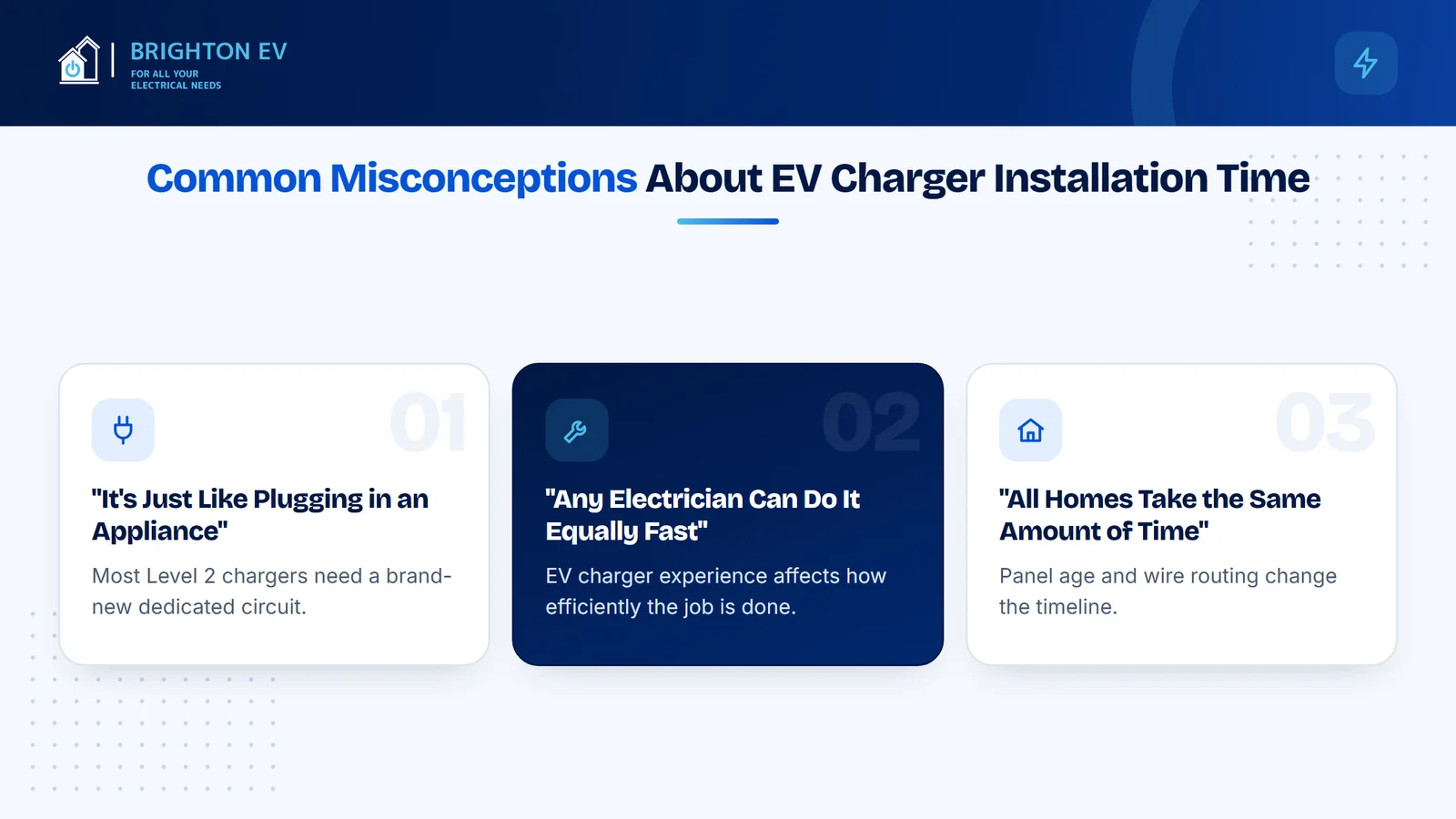
A lot of the frustration homeowners report during installation comes from mismatched expectations rather than anything going wrong. Clearing up a few misconceptions helps set a realistic timeline from the start.
Unlike a dryer or dishwasher that often reuses an existing circuit, most Level 2 chargers require a brand-new dedicated circuit sized specifically for continuous high-amperage draw. Continuous loads like EV charging are treated differently under electrical code than intermittent appliance use, which is part of why the process takes longer than simply plugging something in.
Experience with EV charger installation specifically, including familiarity with Tesla wall connectors and other major charger brands, affects how efficiently the job is completed and how accurately the initial time estimate holds up. An electrician who installs chargers regularly can often spot complications during the assessment that a generalist might miss until mid-installation.
Two homes with seemingly identical garages can have very different timelines depending on panel age, wire routing through walls or attics, and whether the home has had previous electrical work done. This is why a phone quote is always an estimate, and the actual on-site assessment is what determines a firm timeline.
Understanding the variables above makes it easier to plan realistically rather than being surprised by a longer-than-expected project. A little preparation on the homeowner’s side can also shorten the on-site visit.
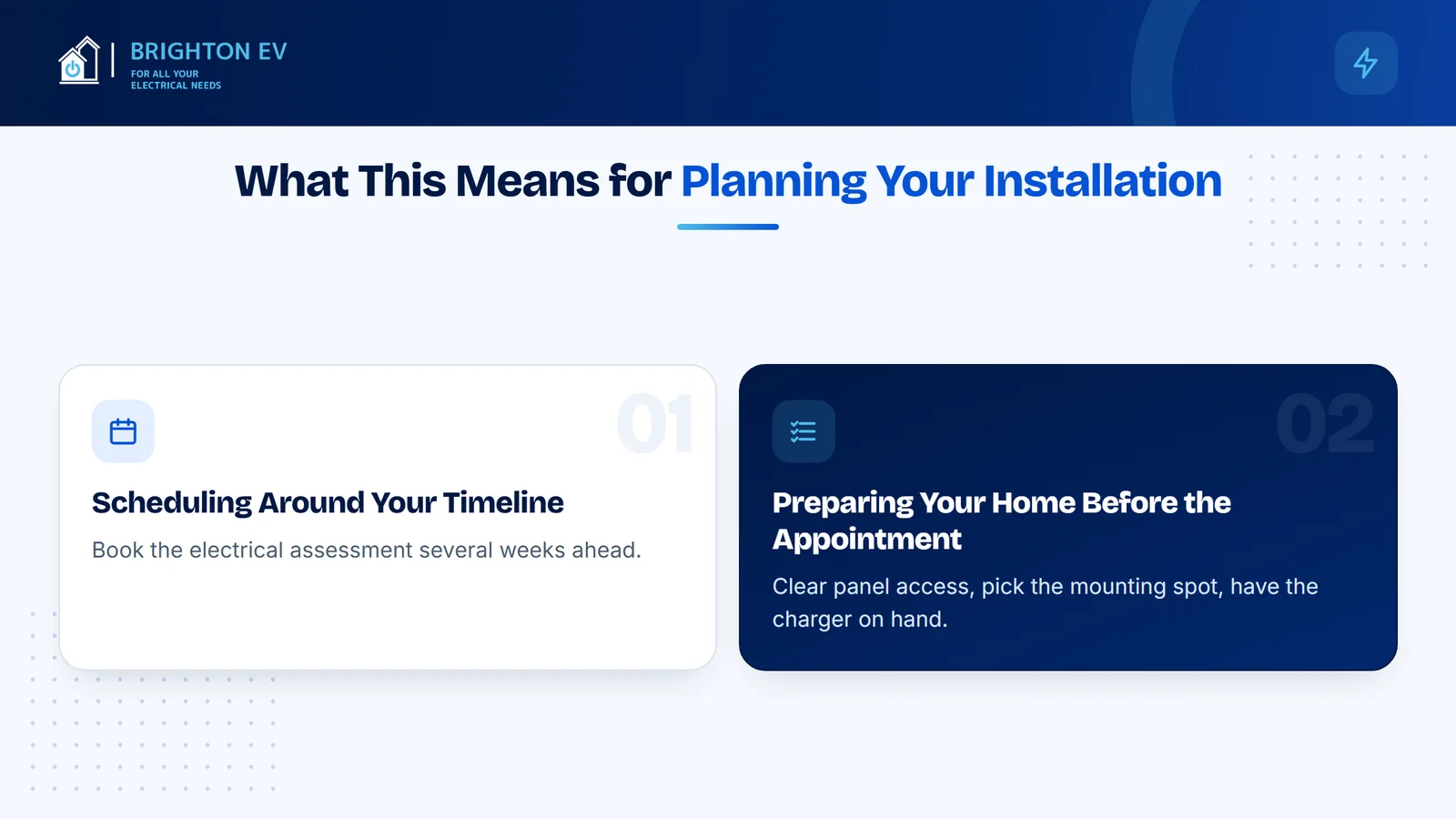
If you’re working with a delivery date for a new vehicle, it’s worth scheduling the electrical assessment several weeks ahead, especially in areas like Gilbert where new-build communities with modern 200-amp panels may move faster through the process than older neighborhoods with legacy electrical systems. Residential electrical services that include EV charger installation as part of a broader home electrical update, such as combining it with lighting upgrades or a panel upgrade, can also be more efficient than scheduling separate visits.
Clearing access to your electrical panel, deciding on the exact mounting location for the charger, and having your charger model or Tesla Wall Connector on hand before the appointment all help the electrician move through the assessment and installation without unnecessary delays. Homeowners who address circuit troubleshooting and repairs for any known electrical issues beforehand also tend to see smoother, faster installation appointments.
Brighton EV provides electrical services for homeowners throughout the Greater Phoenix Area, from new circuit work and panel upgrades to safety inspections and everyday residential electrical needs. Whether you’re planning a new charging setup or exploring what your home’s electrical system can support, our team is available to walk through your options and help you plan a project that fits your timeline. Reach out to discuss your home’s setup.
Most Level 2 home charger installations range from around $500 to $2,000 depending on wiring distance and panel condition, with costs rising toward $3,000 or more if an electrical panel upgrade is required.
It’s not recommended. Level 2 chargers require a properly sized dedicated circuit and must meet local electrical code, so installation should be done by a licensed electrician to avoid safety hazards and failed inspections.
A Tesla Wall Connector installation typically takes about the same 2 to 4 hours as other Level 2 chargers, since the electrical requirements for the dedicated circuit are nearly identical regardless of brand.
A typical EV adds roughly $30 to $60 per month in electricity costs for an average driver, though the exact amount depends on your local utility rate and how many miles you drive.
You can usually charge your vehicle the same day the charger is installed and tested, though some jurisdictions require final permit approval before the circuit is considered fully compliant.
Yes, same-day installation is possible when the home’s panel already has sufficient capacity and no permit inspection is required before energizing the unit, which is common in newer homes with modern electrical panels.
Tell us what you need repaired or installed, and we’ll help plan the right electrical service.
By requesting an estimate, you agree that Brighton EV may call or text you about your request. Message & data rates may apply.